Jawline Definition Without Overfilling
A defined jawline is usually read as a matter of volume. More often, it's a matter of support — and the two call for very different treatment plans.
· 6 min
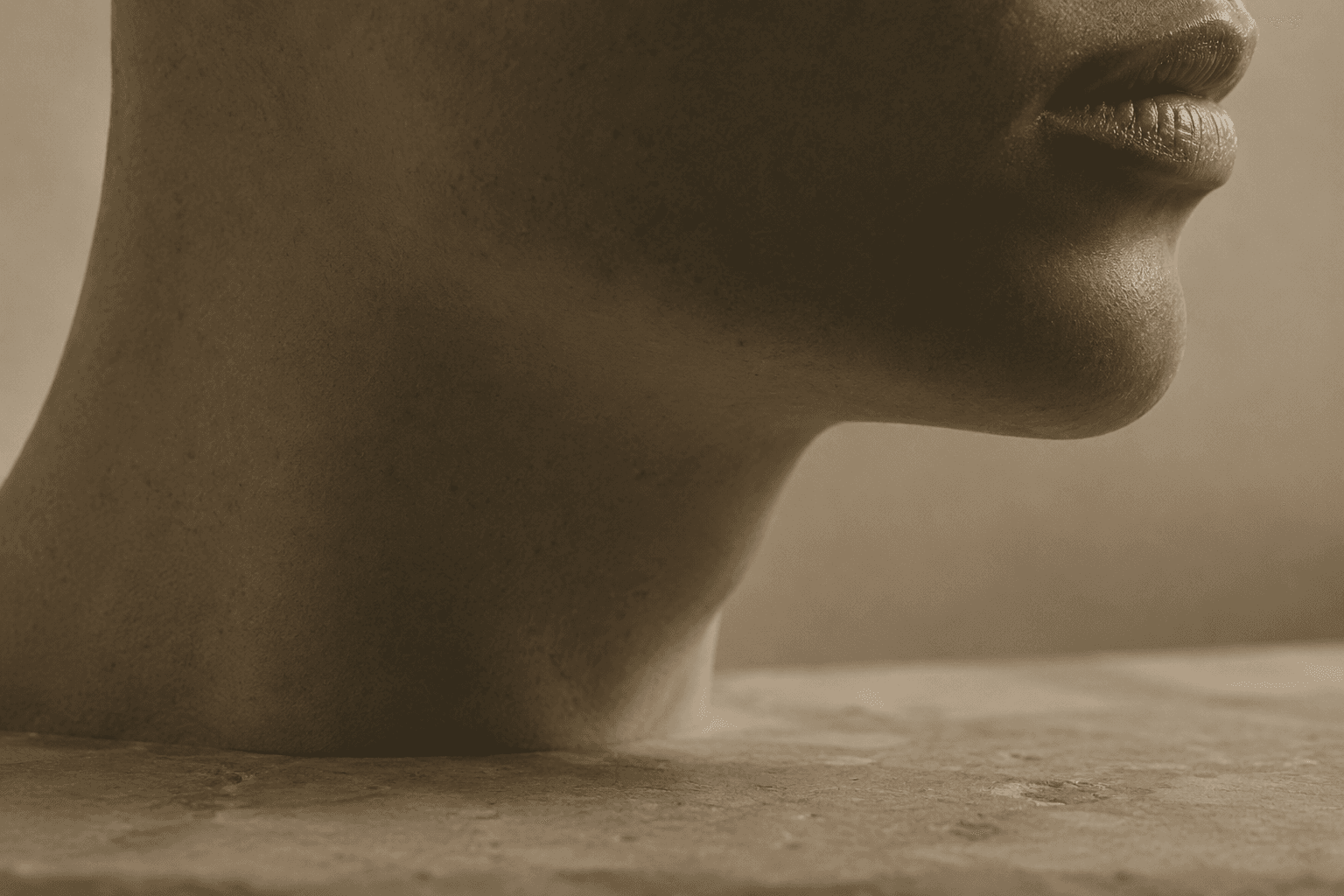
A soft jawline is one of the most common concerns raised in consultation, and one of the most commonly mistreated. The instinct is to add volume along the mandible until a line appears. In practice, this often produces the opposite of definition — a heavier, more blunted lower face that reads as less structured, not more.
Definition is a contrast problem
A jawline reads as 'defined' when there is a clear contrast between the bony edge of the mandible and the soft tissue above and below it. That contrast can be lost two ways: genuine volume loss along the jaw itself, or — more commonly in younger faces — descent and fullness in the jowl and neck that obscures a jawline which is, structurally, still there. That descent follows its own mechanism — ligamentous laxity with a separate timeline from the volume changes elsewhere in the face.
Filling directly along a jawline that is being obscured by jowl fullness adds mass to an area that already has too much, relative to what's above it. The result can look fuller without looking sharper, because the underlying contrast problem was never addressed.
Assessing before adding
A useful assessment distinguishes between a jaw that lacks projection at the bone itself — where carefully placed structural support can genuinely help — and a jaw that has adequate bone but is being visually crowded by soft tissue laxity or fat, where the answer usually lies elsewhere: skin tightening, fat-reducing approaches, or simply time and patience with a less aggressive plan.
A jawline doesn't need more of everything. It needs the one missing piece identified, and nothing added around it.
What overfilling actually looks like
- A jawline that looks wider from the front but no sharper in profile — mass added without contrast
- Loss of the natural taper between the ear and the chin, replaced by a uniformly heavy line
- A jaw that looks structured at rest but distorted in expression, because the tissue is now under tension it wasn't built to carry
- Results that require touch-ups every few months to maintain, rather than settling into a stable structure
The more durable approach usually treats jaw definition as one part of a broader lower-face assessment — including skin laxity, fat distribution, and genuine bone projection — rather than a single line to be filled in isolation. That broader assessment often extends to chin and jaw considered together in profile, since the two are rarely independent.
Frequently Asked Questions
How can I tell if my jawline issue is volume loss or soft tissue laxity?
A useful test is comparing how the jawline looks at rest versus with the skin gently supported upward by hand. If lifting the soft tissue reveals a sharper line underneath, laxity is likely the primary driver rather than a lack of bony or structural support.
Is jawline filler ever the right answer?
Yes, in cases where there is a genuine deficiency in bony or structural projection along the mandible. The distinction is that it's used to restore a specific missing structure, not applied broadly in the hope that more product produces more definition.
Why does an overfilled jawline sometimes look worse in photographs than in the mirror?
Mirrors are typically viewed at a flattering angle and distance. Photographs, especially from below or at an angle, reveal contour changes — like a uniformly heavy jawline — more honestly than a quick mirror check tends to.
Does jawline treatment need to be redone frequently to maintain results?
Structural, well-assessed treatment tends to require less frequent maintenance than treatment aimed only at chasing visible fullness, because it's addressing an actual deficiency rather than being reapplied to sustain an artificial effect.
Clinical Perspective
By Dr. Gan Lee Ping
A request to sharpen a jawline is one of the most common I hear, and one where I slow down before agreeing to anything specific. The instinct — mine included, earlier in my practice — is to reach for filler along the mandible until a line appears. But a jawline that looks soft is not always a jawline that lacks structure. More often than people expect, the bone is adequately projected, and what's actually happening is that jowl fullness or skin laxity above it is obscuring a contrast that's still there.
Filling into that kind of jaw doesn't sharpen it — it adds mass to a region that already has too much relative to what sits above it. So the assessment I do first is simple but not skippable: is this a genuine deficiency in projection, or a masking problem elsewhere? Only the first responds well to volume. The second usually needs a different plan entirely, and saying so up front is, in my experience, more useful to a patient than agreeing to fill first and see.
Selected References
1. Furnas DW. The retaining ligaments of the cheek. Plast Reconstr Surg. 1989;83(1):11-16.
2. Mendelson BC, Wong CH. Changes in the facial skeleton with aging: implications and clinical applications in facial rejuvenation. Aesthet Plast Surg. 2012;36(4):753-760.
3. Hong GW, Wan J, Yoon SE, Yi KH. Anatomic-based diagnosis and filler injection techniques: chin augmentation and jawline contouring. J Craniofac Surg. 2025;36(2):688-694.
About Dr. Gan Lee Ping
Dr. Gan Lee Ping is a Singapore aesthetic doctor with a clinical interest in facial anatomy, evidence-based aesthetic medicine, and natural-looking outcomes. Her educational articles focus on helping readers understand the anatomy, ageing processes and evidence behind aesthetic medicine so they can make informed decisions.
Consultation
Begin with a consultation
Every plan starts with an individual assessment — no protocol is recommended before one.
Book a ConsultationRelated in the Journal

Face
Facial Asymmetry: Structural Baseline Versus Acquired Change
Near-perfect facial symmetry is rare. The useful question is not whether a face is asymmetric, but whether that asymmetry is lifelong or new — because the two call for entirely different responses.
· 6 min
Face
Brow Position: Descent, Compensation, and the Forehead's Role
A meaningful share of the forehead lines seen in consultation are not a forehead problem at all — they are the frontalis muscle's response to a brow that has already started to descend.
· 5 min

Face
Under-Eye Bags Versus Under-Eye Hollowing: Two Different Mechanisms
One is tissue pushing forward. The other is tissue receding. Both get called 'tired eyes,' and a treatment designed for one will not address — and may worsen — the other.
· 5 min