The Curious Case of Erling Haaland and Traction Alopecia: What Tight Ponytails Do to the Hairline
A footballer's tied-back hair is an unlikely but genuinely useful lens for understanding tight ponytail hair loss — the mechanics of traction alopecia, and what protects a hairline built to withstand years of repeated tension.
· 7 min
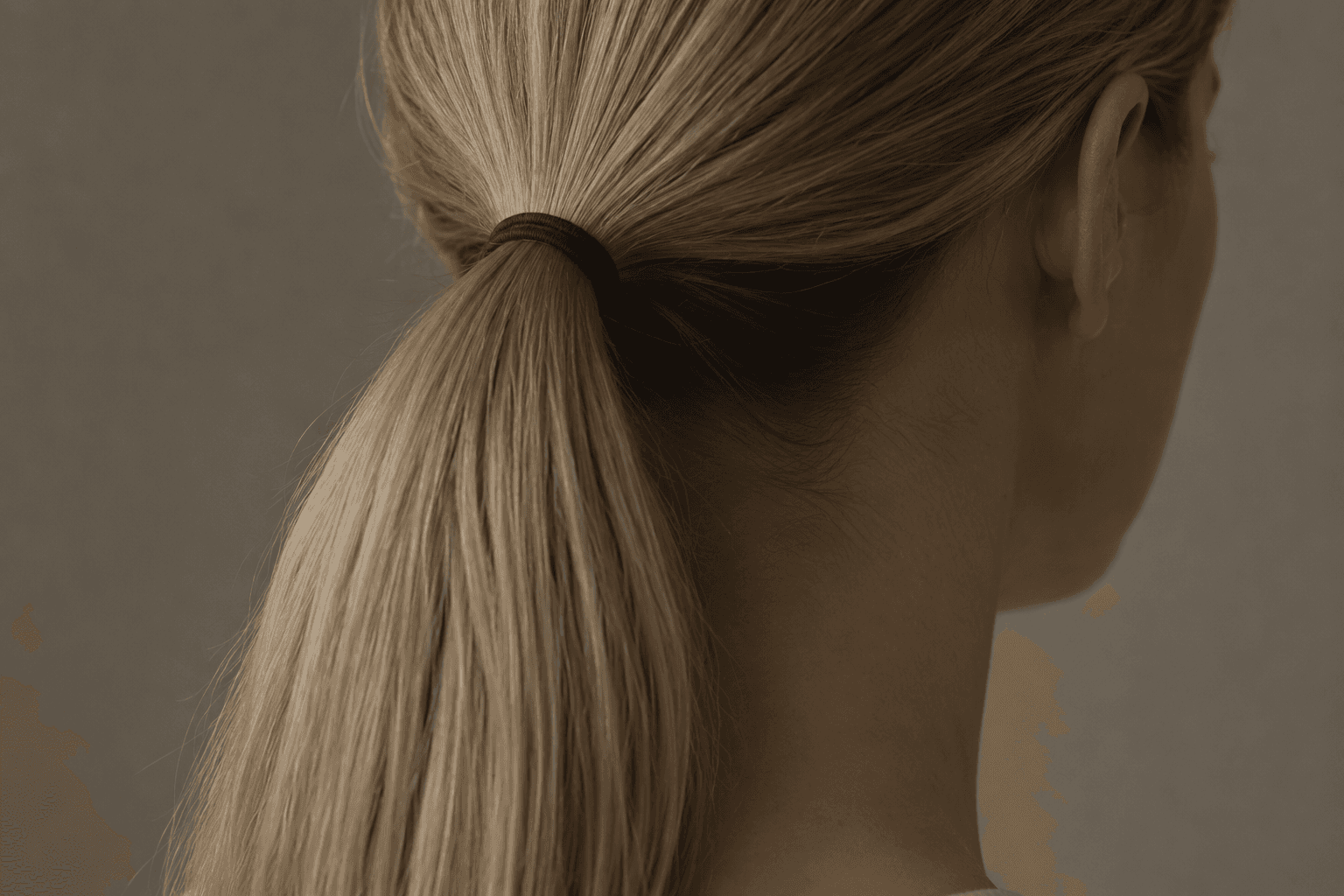
By the middle of this decade, Erling Haaland had become one of the most photographed athletes in world football — a Norwegian striker whose scoring record at Manchester City made him a fixture of season previews and sponsor campaigns. He is discussed for his statistics, but also for one detail in nearly every image of him: hair pulled back in a tight, high ponytail that barely moves as he sprints.
The ponytail has become shorthand for the player: practical, unfussy, slightly severe. It is also a useful case study — not because Haaland's hairline shows any sign of damage (by every public appearance, it looks full and unaffected), but because his hairstyle is close to a textbook illustration of the chronic mechanical tension dermatologists associate with traction alopecia. This article makes no claim about his hair health. It simply uses a recognisable ponytail as an entry point into a condition that affects many people who tie their hair back the same way, year after year.
A signature, not an accident
Elite athletes rarely leave grooming to chance. A tied-back style keeps hair out of the eyes, reduces drag fractionally, and has become part of Haaland's personal brand. But worn only occasionally, a style carries negligible consequence. It is the same tension, applied week after week across a career, that decides whether it remains a choice or turns into a chronic stressor on the scalp.
How a hairstyle becomes biology
Hair is often treated as inert — a cosmetic surface, unaffected by anything short of genetics or hormones. The follicle beneath it is not. It is a living structure, anchored in the dermis and supplied by its own blood vessels. Sustained mechanical force — the kind produced by a tightly bound ponytail, plait or bun — is read by that tissue as genuine, repeated injury. This is the premise behind traction alopecia: hair loss caused not by hormones but by the hairstyle itself, applied with enough force, for long enough, to change the follicle's biology.
What traction alopecia actually is
Traction alopecia is hair loss from prolonged tension on the hair shaft, transmitted directly to the follicle. It is one of the more common causes of hairline thinning worldwide, and one of the more treatable, since the cause is mechanical rather than hormonal. It affects both men and women, though the styles that cause it differ: tight ponytails and buns in dancers and gym-goers; box braids, cornrows and weaves worn under tension; turbans in Sikh men; and tight man-buns, an increasingly recognised pattern in male patients. The mechanism is identical in every case — only the route differs.
The mechanism: from tension to fibrosis
The process follows a predictable sequence. Sustained pulling force produces localised inflammation around the follicle — tenderness, redness or small bumps at the hairline, sometimes called traction folliculitis. If the tension stops here, it typically resolves. If it continues, repeated micro-injury leads to perifollicular fibrosis: scar tissue that does not support hair growth. Once a follicle is sufficiently scarred, it stops producing hair permanently, regardless of what is done afterward. That is the essential shape of the condition: an early, reversible phase, followed — if unaddressed — by a late, largely irreversible one.
Which hairstyles carry the highest risk
- Tight, high ponytails worn daily for exercise or as a default style — the pattern most relevant to athletes
- Box braids, cornrows and weaves, particularly with added synthetic hair
- Buns and top-knots pulled tight enough to visibly lift the frontal hairline
- Chemically relaxed or heat-straightened hair styled under any of the above, since weakened hair fails under lower tension
What unites this list is not the styles themselves but three variables: force applied, duration sustained each day, and years repeated. A tight ponytail worn for a two-hour training session carries only a fraction of the risk of the same ponytail worn from breakfast to bedtime, five days a week, for a decade.
The early signs most people miss
Traction alopecia rarely announces itself as sudden hair loss. It begins quietly at the margins — the frontal hairline, the temples, wherever a hairstyle concentrates its pull — easy to mistake for normal variation.
- Small, tender bumps along the hairline (traction folliculitis), particularly just after a style is tightened
- Redness or flaking confined to the areas under tension, rather than across the whole scalp
- A widening, thinning band along the hairline, sometimes sparing a narrow strip of fine hair at the very edge — the fringe sign
- Broken hairs concentrated at points of maximum tension, rather than spread diffusely
That fringe sign is a useful clue. It distinguishes traction-related thinning from the pattern seen in androgenetic hair loss, which progresses differently and doesn't carry this signature.
Is the damage reversible?
Whether the damage can be undone is the single most consequential question in traction alopecia, and the answer depends entirely on the stage at which it is caught. In the early, inflammatory phase — folliculitis, redness, mild thinning without visible scarring — regrowth is genuinely possible once tension is removed. In the later, fibrotic phase, the affected follicles are gone permanently; no topical treatment, device or supplement will bring them back. Think of it as a race against a slow but real clock, where the interventions that matter most come before scarring develops, not after.
Evidence-based prevention
Prevention, fortunately, is the area with the clearest evidence: the driving cause — mechanical tension — is directly modifiable.
- Alternate hairstyles and tension points rather than wearing the same tight style daily
- Loosen the first inch of hair nearest the scalp; most damage concentrates at the root
- Use soft, fabric-covered ties rather than thin elastic bands
- Treat tenderness or small bumps at the hairline as an early warning sign, not a cosmetic nuisance
None of this requires abandoning a tied-back style; for athletes, that is rarely practical advice. It means treating hairline tension the way a physiotherapist treats any repetitive strain: varying load, allowing recovery, and acting on early symptoms rather than waiting for a visible result.
The most effective treatment for traction alopecia is rarely a prescription. It is a change in how, and how often, the hair is tied.
Practical guidance for athletes and professionals
Anyone who ties their hair back for most of their waking hours — athletes, dancers, surgeons, nurses — sits in a higher-risk category through repetition alone. The adjustments are modest: loosen the style on rest days, rotate the tie's position by an inch, and ease off at the first sign of a sore hairline.
In Singapore's climate specifically, sweat and prolonged dampness under a tight style add further irritation to an already tensioned scalp — part of why the local climate is its own contributing factor to hair thinning.
When to see a specialist
Persistent tenderness at the hairline, a widening thin band, or a fringe sign noticed by a hairdresser are reasonable grounds to seek an assessment. Diagnosis is usually clinical: styling history plus the pattern of thinning, supported by trichoscopy.
Getting that diagnosis right matters, because more than one condition can produce thinning at the frontal hairline. Frontal fibrosing alopecia can look similar, as can androgenetic hair loss, which follows a different distribution and needs its own treatment plan — one reason a generic thickening treatment from a salon rather than a clinical assessment is unlikely to tell the two apart.
Once confirmed early, treatment focuses on removing the causative tension and calming inflammation — sometimes a short course of corticosteroid, alongside topical minoxidil for follicles that remain viable. Where scarring has occurred, minoxidil has nothing left to work with. The main remaining option is hair transplantation into the scarred zone, once the disease is confirmed stable — though outcomes there are more modest than transplantation into healthy tissue.
Where research is heading
The more active area of research isn't a new treatment for established scarring; the biology there is unforgiving. It is earlier detection instead, so that intervention happens inside the reversible window before it closes. Trichoscopic monitoring and public awareness of signs like the fringe sign move in the same direction: catching a mechanical problem while it is still mechanical, before it becomes permanent. Hair preservation, in this condition, is less about finding a better treatment than about better timing: recognising the earliest signals a scalp gives, before years of absorbed tension become impossible to reverse.
Frequently Asked Questions
Does Erling Haaland have traction alopecia?
There is no basis for that claim, and this article does not make it — publicly, his hairline appears full and unaffected. His tied-back style is used here purely as a widely recognisable example of the kind of hairstyle that can, in general, contribute to traction alopecia over years of repetition.
What is the earliest sign of traction alopecia?
Tenderness, redness or small bumps along the hairline where a hairstyle is tightest — traction folliculitis — usually appears before any visible thinning. Noticing and acting on this stage, rather than the thinning that can follow it, is what keeps the condition reversible.
Can traction alopecia be reversed?
Yes, if caught in its early, inflammatory stage before scarring develops — hair regrowth is genuinely possible once the causative tension is removed. Once perifollicular fibrosis has set in, the affected follicles are permanently lost and further styling changes will not bring them back.
Which hairstyles are most likely to cause hair loss?
Tight ponytails, braids, buns, weaves and extensions worn under sustained tension carry the highest risk, especially when combined with chemically relaxed hair or worn in the same position daily for years. Risk scales with the force applied, how long it's sustained each day, and how many years the pattern continues.
Is traction alopecia different in men and women?
The underlying mechanism — chronic mechanical tension on the follicle — is identical in both sexes; what differs is the hairstyle that typically causes it. In women it is more often linked to tight ponytails, braids, weaves and extensions; in men, to turbans and tightly tied top-knots or man-buns. Both male and female traction alopecia are diagnosed and treated the same way.
Clinical Perspective
By Dr. Gan Lee Ping
Traction alopecia is one of the more satisfying conditions to treat, precisely because so much of it is preventable, and because patients arrive already holding the one piece of information a clinician needs most: their own styling history. When someone can tell me exactly which hairstyle they've worn daily, and for how many years, the diagnosis is often clear before I've even examined the trichoscope images.
The harder conversation is usually not about diagnosis but about timing. Patients frequently arrive once thinning is visually obvious, by which point some of what has happened is no longer reversible. I would rather see someone earlier, with nothing more than a tender hairline and a hairstyle they've worn the same way for a decade, because that is precisely the window in which a simple change in habit — rather than any treatment — does most of the work.
Selected References
1. Billero V, Miteva M. Traction alopecia: the root of the problem. Clin Cosmet Investig Dermatol. 2018;11:149-159.
2. Mirmirani P, Khumalo NP. Traction alopecia: how to translate study data for public education—closing the KAP gap? Dermatol Clin. 2014;32(2):153-161.
3. Khumalo NP, Jessop S, Gumedze F, Ehrlich R. Hairdressing is associated with scalp disease in African schoolchildren. Br J Dermatol. 2007;157(1):106-110.
4. James J, Saladi RN, Fox JL. Traction alopecia in Sikh male patients. J Am Board Fam Med. 2007;20(5):497-498.
5. Samrao A, Chen C, Zedek D, Price VH. The fringe sign—a useful clinical finding in traction alopecia of the marginal hair line. Dermatol Online J. 2011;17(11):1.
About Dr. Gan Lee Ping
Dr. Gan Lee Ping is a Singapore aesthetic doctor with a clinical interest in facial anatomy, evidence-based aesthetic medicine, and natural-looking outcomes. Her educational articles focus on helping readers understand the anatomy, ageing processes and evidence behind aesthetic medicine so they can make informed decisions.
Consultation
Begin with a consultation
Every plan starts with an individual assessment — no protocol is recommended before one.
Book a ConsultationRelated in the Journal
Hair
Sudden Hair Shedding After GLP-1 Weight Loss or Stress: How to Stop Acute Telogen Effluvium
A sudden increase in hair shedding two to three months after a major physical or emotional stressor — including rapid weight loss on a GLP-1 medication — has a name, a known timeline, and, in most cases, a genuinely reassuring prognosis.
· 7 min

Hair
Postpartum Hair Loss in Singapore: When Does 'Normal Shedding' Require Medical Intervention?
Nearly every new mother sheds more hair than usual in the months after childbirth. Knowing what counts as the expected pattern — and what doesn't — is what determines whether reassurance or further investigation is the right next step.
· 7 min

Hair
Hair Salons vs Medical Aesthetic Clinics: Why Hair Spa Treatments May Not Stop Hair Loss
A hair spa treatment and a medical hair loss assessment are not competing versions of the same thing. They address different layers of the problem, and knowing which one applies is the more useful question than which is 'better.'
· 6 min