The Early Signs of Hair Thinning Most People Miss
By the time thinning is obvious in a photograph, the underlying process has often been active for a year or more. The earlier signs are quieter and easy to dismiss.
· 5 min
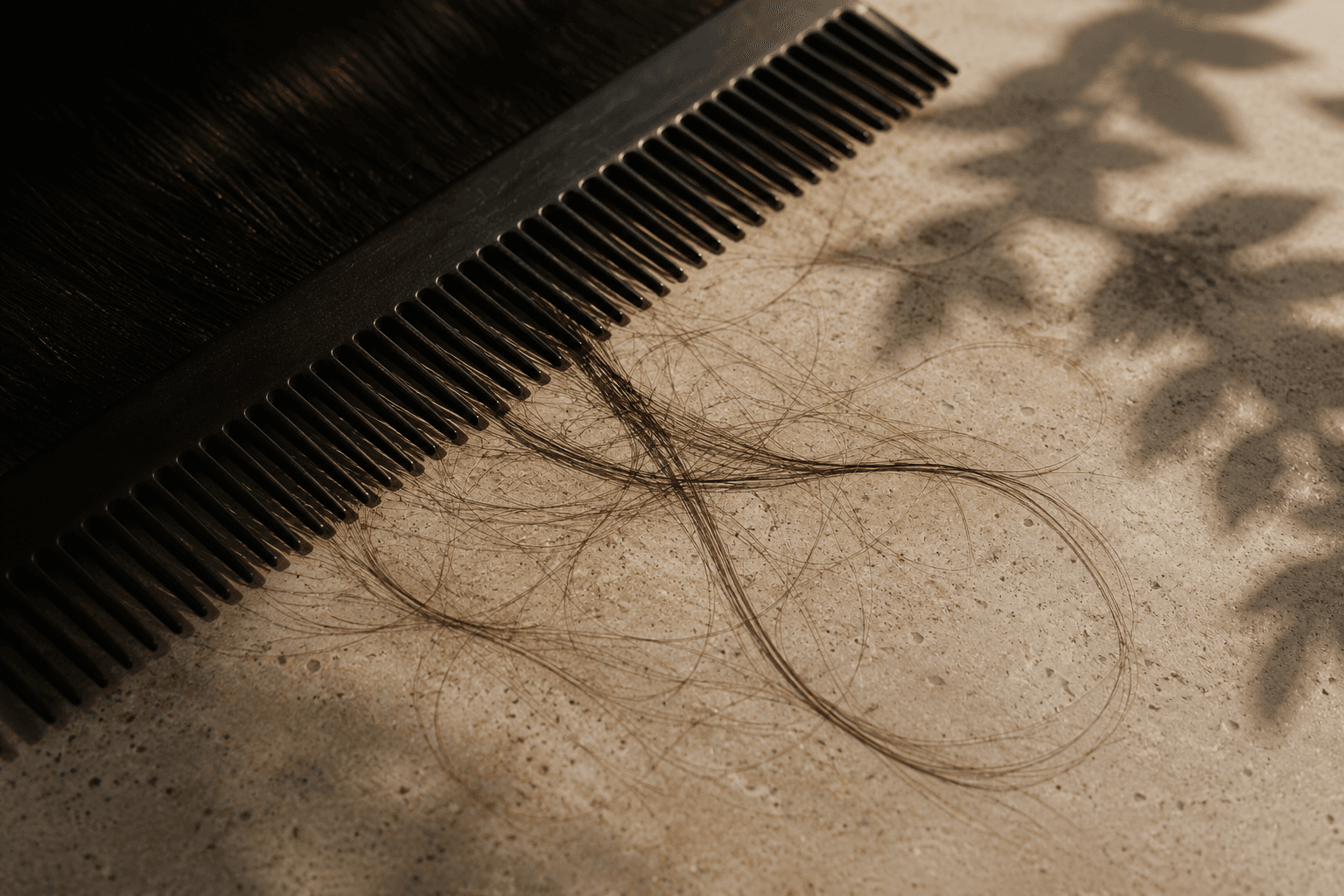
Hair thinning is rarely sudden. It is a gradual shift in the ratio of hairs in active growth versus resting phase, and by the time it's visible as reduced density in a mirror or photograph, that shift has usually been underway for a considerable period.
Signs that precede visible thinning
- A wider-than-usual amount of hair on the pillow, in the shower drain, or in a hairbrush — noticeable to the person experiencing it before it's noticeable to others
- A change in hair texture, with new growth appearing finer or softer than the surrounding hair
- A widening part line, often noticed first from an overhead photograph rather than a mirror
- Increased scalp visibility under bright, direct light, before it's visible under normal indoor lighting
None of these signs alone is diagnostic — shedding fluctuates naturally with season, stress, and hormonal changes. What matters is a sustained pattern over several months, rather than a single noticeable week.
Why early action changes the outcome
Hair follicles that have miniaturised for an extended period become progressively harder to restore to their original size. Intervening while follicles are still active, even if visibly thinning, has a meaningfully different prognosis than intervening after a follicle has been dormant for years.
The best time to address hair thinning is before it looks like hair thinning to anyone else.
What a first assessment looks at
A useful first assessment goes beyond a visual scalp check — it typically includes a review of family history, recent hormonal or medical changes, nutritional status (iron and thyroid markers in particular), and, where relevant, magnified scalp imaging to assess follicle density and miniaturisation directly rather than by estimation. It should also include a direct look at scalp health, since circulation and inflammation at the scalp level can influence outcomes independently of the hormonal picture.
The same principle — that the visible sign lags well behind the underlying process — governs skin longevity just as it does hair, which is why both reward consistent early habits over a reactive response to something already visible.
Frequently Asked Questions
Is increased shedding always a sign of thinning?
No — shedding naturally increases seasonally and after stressors like illness, significant weight change, or hormonal shifts, and typically resolves on its own within a few months. Sustained shedding over more than three to four months is the more meaningful signal.
At what point should someone seek an assessment rather than waiting?
If any of the early signs persist beyond three months, or if there's a strong family history of early-onset thinning, an earlier assessment is generally more useful than a later one, given how much prognosis depends on timing.
Can nutritional deficiency alone cause the early signs of thinning?
Yes — iron deficiency and thyroid dysfunction in particular can produce shedding patterns that closely resemble early androgenetic thinning, which is part of why bloodwork is a standard part of a thorough assessment.
Does early intervention mean starting treatment immediately?
Not necessarily — early assessment sometimes concludes that monitoring, rather than active treatment, is the appropriate next step. The value of acting early is having an accurate baseline, whatever the subsequent plan turns out to be.
Clinical Perspective
By Dr. Gan Lee Ping
By the time a patient books a consultation specifically about hair thinning, they've often noticed something for months already — more hair on the pillow, a part that looks slightly wider in a photo than it does in the mirror. I take these early observations seriously, even when the mirror still looks 'normal,' because the biology behind them tends to be further along than the visible change suggests.
Early assessment doesn't always lead to immediate treatment, and I'm comfortable telling a patient that monitoring is the right next step rather than intervention. What I'm not comfortable doing is waiting for thinning to become obvious before taking the observation seriously, because follicles respond differently depending on how long they've been in decline.
Selected References
1. Rudnicka L, Olszewska M, Rakowska A, Kowalska-Oledzka E, Slowinska M. Trichoscopy: a new method for diagnosing hair loss. J Drugs Dermatol. 2008;7(7):651-654.
2. İritaş SY, Özcan D. The value of trichoscopy in the follow-up of treatment response in patients with androgenetic alopecia. Dermatol Pract Concept. 2024;14(1):e2024001.
3. Whiting DA, Waldstreicher J, Sanchez M, Kaufman KD. Measuring reversal of hair miniaturization in androgenetic alopecia by follicular counts in horizontal sections of serial scalp biopsies: results of finasteride 1 mg treatment of men and postmenopausal women. J Investig Dermatol Symp Proc. 1999;4(3):282-284.
About Dr. Gan Lee Ping
Dr. Gan Lee Ping is a Singapore aesthetic doctor with a clinical interest in facial anatomy, evidence-based aesthetic medicine, and natural-looking outcomes. Her educational articles focus on helping readers understand the anatomy, ageing processes and evidence behind aesthetic medicine so they can make informed decisions.
Consultation
Begin with a consultation
Every plan starts with an individual assessment — no protocol is recommended before one.
Book a ConsultationRelated in the Journal

Hair
The Curious Case of Erling Haaland and Traction Alopecia: What Tight Ponytails Do to the Hairline
A footballer's tied-back hair is an unlikely but genuinely useful lens for understanding tight ponytail hair loss — the mechanics of traction alopecia, and what protects a hairline built to withstand years of repeated tension.
· 7 min
Hair
Sudden Hair Shedding After GLP-1 Weight Loss or Stress: How to Stop Acute Telogen Effluvium
A sudden increase in hair shedding two to three months after a major physical or emotional stressor — including rapid weight loss on a GLP-1 medication — has a name, a known timeline, and, in most cases, a genuinely reassuring prognosis.
· 7 min

Hair
Postpartum Hair Loss in Singapore: When Does 'Normal Shedding' Require Medical Intervention?
Nearly every new mother sheds more hair than usual in the months after childbirth. Knowing what counts as the expected pattern — and what doesn't — is what determines whether reassurance or further investigation is the right next step.
· 7 min