Why Does My Face Look Long? Understanding Asian Facial Length and Proportion
Facial length is never read on its own. It is read against the width of the face and against how its height is shared between the upper, middle and lower face, and with age those relationships can change.
By Dr. Gan Lee Ping · · 13 min

Facial length is not seen in isolation. The eye reads it in proportion: against the width of the face, and against how the height is shared between the upper, middle and lower face.
That is why a face can look long for quite different reasons:
- The whole face is long, from hairline to chin
- One part of it is long for the rest, most often the midface, the lower face or the chin
- The face is relatively narrow, so ordinary height reads as length
- Ageing has changed how height, width and soft tissue relate to one another
In a mirror these can look alike, and many faces combine two of them. But they have different structures behind them, and they lead to different decisions. Sometimes the right decision is to change nothing.
A face looks long in proportion to something: its width, or the rest of its height.
How is facial length judged?
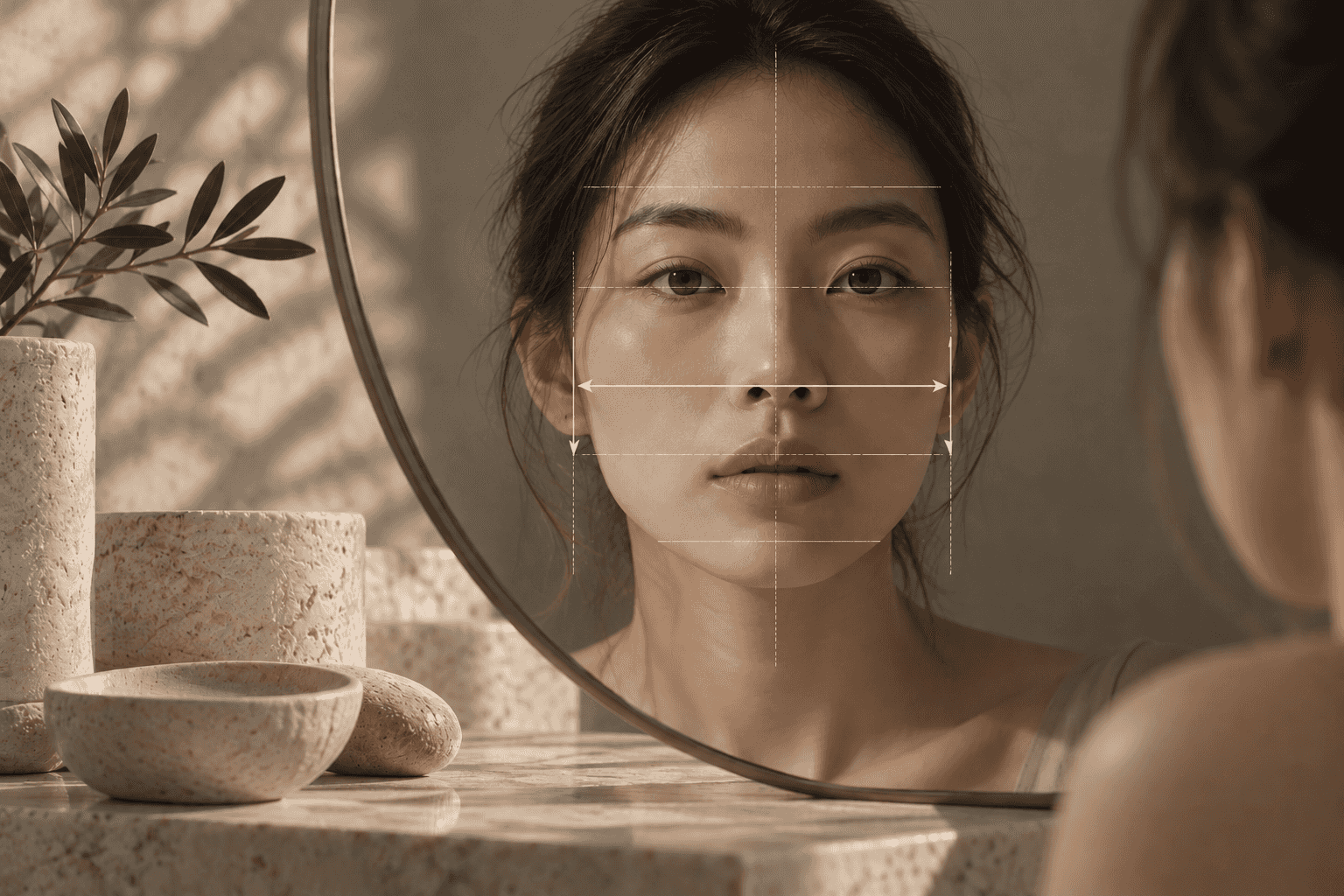
In clinical description, length is a ratio, not a number. One commonly used anthropometric measure is the facial index, which relates facial height to facial width. In the convention used here, facial height, from the bridge of the nose to the bottom of the chin, is divided by the width across the cheekbones and expressed as a percentage. A higher value then describes a face that is relatively longer and narrower. Sources set the boundary of a "long" face at different values, as Why Does My Face Look Wide? explains, so the index describes a face without grading it.
Height is also divided into thirds: from the hairline to the brow, from the brow to the base of the nose, and from the base of the nose to the bottom of the chin. Classical guidelines treat the three as equal. Measured faces do not follow that rule. Le and colleagues measured young Chinese, Vietnamese and Thai adults (60 in each group) and 60 North American Caucasians, and the thirds were not equal in any of the four groups. Thirds are useful for locating where the height sits. They are not a standard a face has to meet, a distinction Does the Golden Ratio Apply to Asian Faces? examines more fully.
Two consequences follow. The same height can look long on a narrow face and ordinary on a broader one. And a relatively long face can look entirely balanced when its width at each level keeps pace with its height. Length is not a fault in itself.
Is it my midface, my lower face or my whole face?
A photograph can give a rough sense of which third carries the height, if it is taken face-on and not at close range. Close-range selfies distort proportion: in one study, they made the nose measure on average about 6% longer than clinical photographs did.
Even a good photograph can only suggest where the height sits. It cannot show whether that height comes from soft tissue, from the teeth or from the jaws. That is the question that decides what, if anything, would help.
The six patterns below are a clinical way of organising what is seen, not a validated scientific classification.
The whole face is long
All three thirds are generous and the face is tall for its width, while the thirds remain in proportion with one another. This is often simply the architecture of that face. The useful question is whether anything within it is out of keeping with the rest.
The midface looks long
A long midface means height in the middle of the face, but the term is used in two ways. In facial thirds, the middle third runs from the brow to the base of the nose, so its height is largely the length of the nose. In everyday aesthetic language, however, "long midface" is often used to describe a long-looking distance between the eyes and the mouth. When that distance looks long, three structures may be involved: the transition from the lower eyelid to the cheek, the length of the nose, and the height of the upper lip. The upper lip can lengthen with age.
Height and projection are separate questions. A midface can look long and still come forward well, or look flat without being long, as Why Does My Midface Look Flat? explains.
The lower face looks long
The lower third runs from the base of the nose to the bottom of the chin. When it carries most of the height, the face can look long even when the forehead and nose are of ordinary length.
Observers notice this. In a study by Johnston and colleagues, 92 university students rated profile silhouettes in which only the height of the lower face had been changed. They rated average proportions most attractive. A lower face lengthened by a given amount was rated less attractive than one shortened by the same amount, and was more often judged to need treatment. The images were silhouettes, so the study shows that people are sensitive to lower-face height. It does not set a target for any face.
A long lower face may come from soft tissue, from the teeth or from the jaws. In long face syndrome, described by Schendel and colleagues in 31 adults, the excess height is associated with excessive vertical growth of the upper jaw. Lips that part at rest or meet only with strain, a large amount of upper teeth or gum on show, and front teeth that do not meet can be signs that the jaws are involved. Signs like these call for an orthodontic or maxillofacial opinion, with X-rays, not an aesthetic assessment alone.
The chin is long
A long chin can make the whole face look longer, because the chin's height is part of the face's height. Classical guidelines divide the lower face into thirds, giving the upper lip, the lower lip and the chin about a third each. The eye is more tolerant than that. In a study by Naini and colleagues, orthognathic patients, clinicians and lay people rated frontal images in which chin height had been altered in small steps, and a surprisingly broad range of chin heights went largely unnoticed. A chin somewhat longer than a third of the lower face is not, on that basis alone, what makes a face look long.
A long chin can also sit further back. A longer lower face can rotate the lower jaw backwards, taking the chin with it. That is how a face can look long while its chin looks small. Short Chin vs Recessed Chin explains how chin height and projection are told apart, and What Makes an Asian Face Look Balanced From the Side? how the chin is read with the nose and lips.
The face is narrow
A narrow face can look longer than it is. Because length is judged against width, ordinary height reads as length when the width does not keep pace. That follows from how facial proportion is described. It is clinical reasoning, not a tested finding about perception.
Where the narrowness lies matters. A face that is narrow only at the temples has a different outline from one that is narrow throughout. Temple contour depends substantially on soft tissue, and temple hollowing is easily overlooked. How width is read at the cheekbone is explained in High Cheekbones vs Wide Cheekbones.
The face looks longer than it used to
In this pattern, the face did not always look this way. What has changed may be height, width or both, as the next section explains.
The table sets the six patterns side by side. It is not a self-test. The same appearance can have more than one cause, and telling them apart takes an examination.
| What the person notices | What may be involved | Why shortening one area may not change it |
|---|---|---|
| "My whole face is long" | Generous height in all three thirds, relative to width | The face may already be in proportion with itself |
| "The space between my eyes and mouth looks long" | The lower eyelid and cheek, the length of the nose, the height of the upper lip | These are three different structures |
| "The bottom half of my face looks long" | The lips, the teeth, the vertical position of the jaws | Soft-tissue treatment does not move the jaws |
| "My chin looks long" | Chin height, sometimes with limited projection | Adding projection can add to apparent length |
| "My face looks long and thin" | Width at the temples, cheekbones or jaw | The height may be ordinary |
| "My face looks longer than it used to" | Soft tissue sitting lower, a longer upper lip, lost fullness at the sides | What has changed may be width, not height |
Why does my face look longer as I age?
Facial ageing is not simply a process of the facial skeleton becoming taller. Bone remodels region by region, while the soft tissues also change in position, volume and shape.
Bone. In CT scans of 120 Caucasian adults, Shaw and colleagues found the height of the lower jaw smaller in older age groups. A 2026 review of facial bone ageing reported that, across the studies it included, the height of the upper jaw decreased by 8–15%.
Soft tissue. In three-dimensional scans of 192 Korean women, total facial height, from hairline to chin, was similar across age groups. How that height was shared was not. Compared with women aged 20 to 39, women aged 60 to 79 had a lower face about 3 mm longer and a philtrum, the groove above the upper lip, about 2.5 mm longer. The forehead section was shorter and the middle section unchanged. In 171 Japanese men scanned twice, about ten years apart, the measured changes included drooping of the upper lip and of the facial folds.
Width. As support along the jawline loosens and fullness descends, a process with its own timeline, the lower outline of the face can extend downwards. Hollowing at the temples or the side of the cheek can narrow the face above. Significant weight loss can narrow it further, a change discussed in relation to GLP-1 medicines. A face that is narrower above and heavier below can read as longer with no bony height added. That is clinical interpretation drawn from these findings.
The Korean study compared different women at different ages, and the bone data come partly from Caucasian samples, so none of this predicts how a particular face will change. Earlier photographs are often the clearest way to tell a face that has always been long from one that has come to look longer.
Do Asian faces have a typical vertical proportion?
Not one that applies to every Asian face. Le and colleagues described a lower face smaller than the forehead height as characteristic of their Chinese, Vietnamese and Thai samples. Gu and colleagues compared X-rays of Chinese and Caucasian young adults with normal bites and well-balanced faces, and found the bony height of the lower face greater, on average, in the Chinese women. The two studies measured different things in different groups: the surface of the face in one, bone in the other. None of the studies cited here measured Malay or Indian faces. In Singapore, where Chinese, Malay, Indian, Eurasian and other faces are seen side by side, no one vertical proportion describes an Asian face, and sample averages cannot set the right proportions for an individual.
This matters because much aesthetic guidance for Asian faces assumes the opposite concern. The Asian Facial Aesthetics Expert Consensus Group, a panel of 21 experts from 11 Asia-Pacific countries, described Asian faces as tending to be wider with shorter vertical height. The same group's 2016 recommendations for East and Southeast Asian patients named vertical lengthening of facial height and narrowing of the lower face as key aims, and reported treating the chin for projection and elongation. These are expert opinions, offered as generalisations. For a face that is already long relative to its width, those general aims may not be appropriate: narrowing the face or adding vertical height can accentuate the proportions that already create the impression of length. That is a proportional inference, not an outcome the consensus papers tested.
Can jaw slimming or chin filler make a long face look longer?
Yes, in some faces. Neither treatment is a mistake in itself. Each changes one relationship, and its effect depends on the face around it.
Chin filler adds projection and, depending on how it is placed, height. In a face that is long in the lower third, added height adds to the length. Preference research points the same way. In a Korean study, 75 dental students ranked chin positions on three-dimensional images of broad, average and long faces. The preferred chin was slightly less projected on the long faces than on the broad ones, and on the long female face a slightly retruded chin was preferred. The faces were few and the raters young, but the chin that looked right depended on the face it belonged to.
Jaw slimming with botulinum toxin reduces the masseter, the chewing muscle at the corner of the jaw. It narrows the lower face when that muscle contributes to its width. In a face that is already narrow for its height, a narrower jaw can make it read as longer. That is clinical reasoning, not a measured outcome. The consensus panel noted separately that in older patients, with age-related volume loss and reduced skin elasticity, reducing the masseter can worsen facial appearance, with hollowness and jowl formation. Square Jaw in Asian Faces explains when the masseter is the source of width, and V-Shaped Face why a narrower jaw does not always make a face look slimmer.
Filler may restore width where width has been lost, at the temple or the side of the cheek. It does not shorten a lower face whose height lies in the teeth or jaws. Injectables change soft tissue and muscle, not the position of the jaws, and where the jaws are the source, an orthodontist or maxillofacial surgeon is the right first opinion. All of these are medical procedures with risks of their own.
How should a long Asian face be assessed?
By asking where the impression of length comes from, before asking how to reduce it.
Asian Facial Architecture™, Dr. Gan Lee Ping's framework for reading each face against its own structure, treats facial length as a relationship. The face is examined down its height, to see which third carries it. It is examined across its width, at the temples, the cheekbones and the jaw. And it is placed in time, to separate what has always been there from what has changed. In practice, that means looking at:
- The face from the front, at an angle and in profile, at rest and in expression
- Which third carries the height
- Width at the temples, cheekbones and jaw, relative to height
- The upper lip, how much tooth shows at rest and in a smile, and whether the lips meet without strain
- The chin's height and projection, and how it sits with the lips, nose and jaw
- The soft tissue along the jawline and beneath the chin
- Earlier photographs, where they exist
Some of this can be glimpsed in a mirror. Much of it cannot: whether the height lies in soft tissue, teeth or bone, how width and height interact from every angle, and whether a change has come with time. Where the jaws or the bite may be involved, an orthodontist or maxillofacial surgeon may be the right person to see first.
The useful question is not how long a face is. It is where its length comes from.
Assessing a long face in Singapore
If you recognise your face in one of these patterns, or in more than one, the next step is not choosing a treatment to shorten or slim it. It is finding out which relationship is creating the impression.
In assessing facial length in Singapore, Dr. Gan Lee Ping looks at which part of the face carries the height, how that height relates to width at each level, and whether what the patient notices reflects longstanding anatomy or change that has come with time.
Sometimes the answer is one precise change. Sometimes it lies with the teeth or the jaws. And sometimes a long face is already in proportion, and the most useful finding is to leave it as it is.
Frequently Asked Questions
Why does my face look long?
Facial length is judged in proportion, so a face can look long for several reasons. The whole face may be long. One part of it, often the midface, the lower face or the chin, may be long for the rest. The face may be relatively narrow, so ordinary height reads as length. Or ageing may have changed how height, width and soft tissue relate. Many faces combine more than one, and which applies differs from face to face.
What is a long midface?
A long midface means height in the middle of the face, but the term is used in two ways. In facial thirds, the middle third runs from the brow to the base of the nose, so its height is largely the length of the nose. In everyday aesthetic language, however, "long midface" is often used to describe a long-looking distance between the eyes and the mouth. The lower eyelid and cheek, the nose and the upper lip may each contribute to that impression.
Why does my face look longer as I get older?
Facial ageing is not simply a process of the facial skeleton becoming taller. In a study of 192 Korean women, total facial height was similar across age groups, but the lower face and the philtrum were longer in women aged 60 to 79 than in those aged 20 to 39. Descent along the jawline and loss of fullness at the temples and sides of the face can also make a face read as longer.
Does a narrow face look longer?
It can. Facial length is judged against width, so a face of ordinary height can look long when it is relatively narrow at the temples, the cheekbones or the jaw. This follows from how facial proportion is described and is a matter of clinical reasoning. Where the narrowness lies, and whether it has always been there or has developed with age, affects what, if anything, would help.
Can chin filler or jaw slimming make a long face look longer?
In some faces, yes. Chin filler can add height as well as projection, which adds to a lower face that is already long. Jaw slimming with botulinum toxin narrows the lower face, and in a face already narrow for its height, that can increase the impression of length. Neither is wrong in itself. The effect depends on which part of the face is creating the length, which is why the cause should be identified first.
Clinical Perspective
By Dr. Gan Lee Ping
When someone tells me their face looks long, I do not begin by asking how to make it shorter. I first ask what is creating that impression.
Sometimes the height is real. Sometimes the face is relatively narrow. Sometimes one part of the face — the midface, lower face or chin — carries more of the vertical proportion. And sometimes what the patient is noticing is a change that has appeared with age.
This distinction matters because making a face narrower is not always slimming, and making a chin more projected is not always balancing. A treatment that improves one facial architecture can exaggerate another.
That is why I assess facial length as part of the whole face: height against width, one region against another, and the face now against the face it used to be.
References
1. Choudhary U, Akhtar MJ, Gupta M, More RS, Mishra A. An anthropometric study of the facial index among undergraduate medical students at the Institute of Medical Sciences, Banaras Hindu University, Uttar Pradesh. Cureus. 2026;18(6):e111443.
2. Le TT, Farkas LG, Ngim RC, Levin LS, Forrest CR. Proportionality in Asian and North American Caucasian faces using neoclassical facial canons as criteria. Aesthetic Plast Surg. 2002;26(1):64-69.
3. Pressler MP, Kislevitz ML, Davis JJ, Amirlak B. Size and perception of facial features with selfie photographs, and their implication in rhinoplasty and facial plastic surgery. Plast Reconstr Surg. 2022;149(4):859-867.
4. Johnston DJ, Hunt O, Johnston CD, Burden DJ, Stevenson M, Hepper P. The influence of lower face vertical proportion on facial attractiveness. Eur J Orthod. 2005;27(4):349-354.
5. Schendel SA, Eisenfeld J, Bell WH, Epker BN, Mishelevich DJ. The long face syndrome: vertical maxillary excess. Am J Orthod. 1976;70(4):398-408.
6. Naini FB, Donaldson AN, McDonald F, Cobourne MT. Influence of chin height on perceived attractiveness in the orthognathic patient, layperson, and clinician. Angle Orthod. 2012;82(1):88-95.
7. Guyuron B, Michelow BJ, Willis L. Practical classification of chin deformities. Aesthetic Plast Surg. 1995;19(3):257-264.
8. Shaw RB Jr, Katzel EB, Koltz PF, Kahn DM, Girotto JA, Langstein HN. Aging of the mandible and its aesthetic implications. Plast Reconstr Surg. 2010;125(1):332-342.
9. Lee KWA, Zamin RZ, Sobchyshyn M, Song JK, Liang BC, Park S, Fai WK, Park Y, Yi KH. Facial bone aging: an update and literature review. JPRAS Open. 2026;48(4):828-845.
10. Kwon SH, Choi JW, Kim HJ, Lee WS, Kim M, Shin JW, Na JI, Park KC, Huh CH. Three-dimensional photogrammetric study on age-related facial characteristics in Korean females. Ann Dermatol. 2021;33(1):52-60.
11. Imaizumi K, Taniguchi K, Ogawa Y, Matsuzaki K, Nagata T, Mochimaru M, Kouchi M. Three-dimensional analyses of aging-induced alterations in facial shape: a longitudinal study of 171 Japanese males. Int J Legal Med. 2015;129(2):385-393.
12. Gu Y, McNamara JA Jr, Sigler LM, Baccetti T. Comparison of craniofacial characteristics of typical Chinese and Caucasian young adults. Eur J Orthod. 2011;33(2):205-211.
13. Liew S, Wu WT, Chan HH, et al. Consensus on changing trends, attitudes, and concepts of Asian beauty. Aesthetic Plast Surg. 2016;40(2):193-201.
14. Wu WT, Liew S, Chan HH, et al. Consensus on current injectable treatment strategies in the Asian face. Aesthetic Plast Surg. 2016;40(2):202-214.
15. Choi JY, Kim T, Kim HM, Lee SH, Cho IS, Baek SH. Effect of frontal facial type and sex on preferred chin projection. Korean J Orthod. 2017;47(2):108-117.
About Dr. Gan Lee Ping
Dr. Gan Lee Ping is a Singapore-based aesthetic physician, international speaker and physician trainer. Asian Facial Architecture™ is her framework for understanding facial structure, proportion, soft tissue and ageing as one interconnected system. Her educational articles explain the anatomy and evidence behind aesthetic medicine so that readers can make informed decisions.
Consultation
Where does the length come from?
A face can look long because of one part of its height, its width, or changes over time. An individual assessment identifies which, before deciding whether anything should change.
Arrange a Facial AssessmentExplore Asian Facial Architecture™

Does the Golden Ratio Apply to Asian Faces?
The golden ratio may describe some faces. The evidence does not support using it to define beauty, or to decide what a face should become.
· 9 min
Why Does My Face Look Wide? Understanding Facial Width
A face can look wide for more than one reason. The sources reviewed here measure width in more than one way, and they do not agree on where "wide" begins.
· 11 min

Square Jaw in Asian Faces: Is It Bone, Masseter Muscle or Soft Tissue?
A square jaw is a shape, not a diagnosis. Bone, muscle, soft tissue and proportion can each create it, and the reason matters more than the shape.
· 10 min