V-Shaped Face: What Actually Makes an Asian Face Look Slimmer?
A face can look slimmer without becoming narrower. How slim it looks depends on its outline: where it is wide, how it narrows towards the chin, how long it is, and how clearly the jawline is drawn.
By Dr. Gan Lee Ping · · 11 min

Two faces can measure almost the same across the cheekbones and the jaw, and one can still look noticeably slimmer.
How slim a face looks depends less on any single width than on its outline. That outline is shaped by how broad the face is at each level, how it narrows towards the chin, how long it is for its width, and how clearly the jawline is drawn. A jaw can be made narrower without the face looking slimmer. A face can look slimmer without the jaw changing at all.
What is a V-shaped face?
"V-shaped face" is not a medical term. It describes an outline: a face that is fuller at the cheeks and narrows smoothly through the jaw to the chin.
The closest clinical description comes from the Asian Facial Aesthetics Expert Consensus Group, a panel of clinicians who treat Asian patients. In 2016, it described the oval face as a smooth, egg-shaped curve running from the forehead through the temples, around the cheeks, past the angle of the jaw and along the jawline to the chin, "without indentations or projections in the line". It named an oval face with a neat V-shaped jawline as a current ideal for the female Asian face, and noted that beauty is influenced by customs, traditions and trends.
Two things follow from that. The definition is about how smoothly a line runs. It says nothing about how narrow any part of the face should be. And it records a cultural preference as clinicians saw it in 2016. It is not a description of anatomy, and it is not a standard that any face has to meet.
"Asian" is not one face either. The panel's own definition covered East and Southeast Asia and left out the Indian subcontinent. Most of the studies cited in this article measured Chinese, Korean or Taiwanese faces; where a study did not, the article says so. In Singapore, where Chinese, Malay, Indian, Eurasian and many other faces are seen side by side, no single outline describes an Asian face.
What makes a face look slimmer?
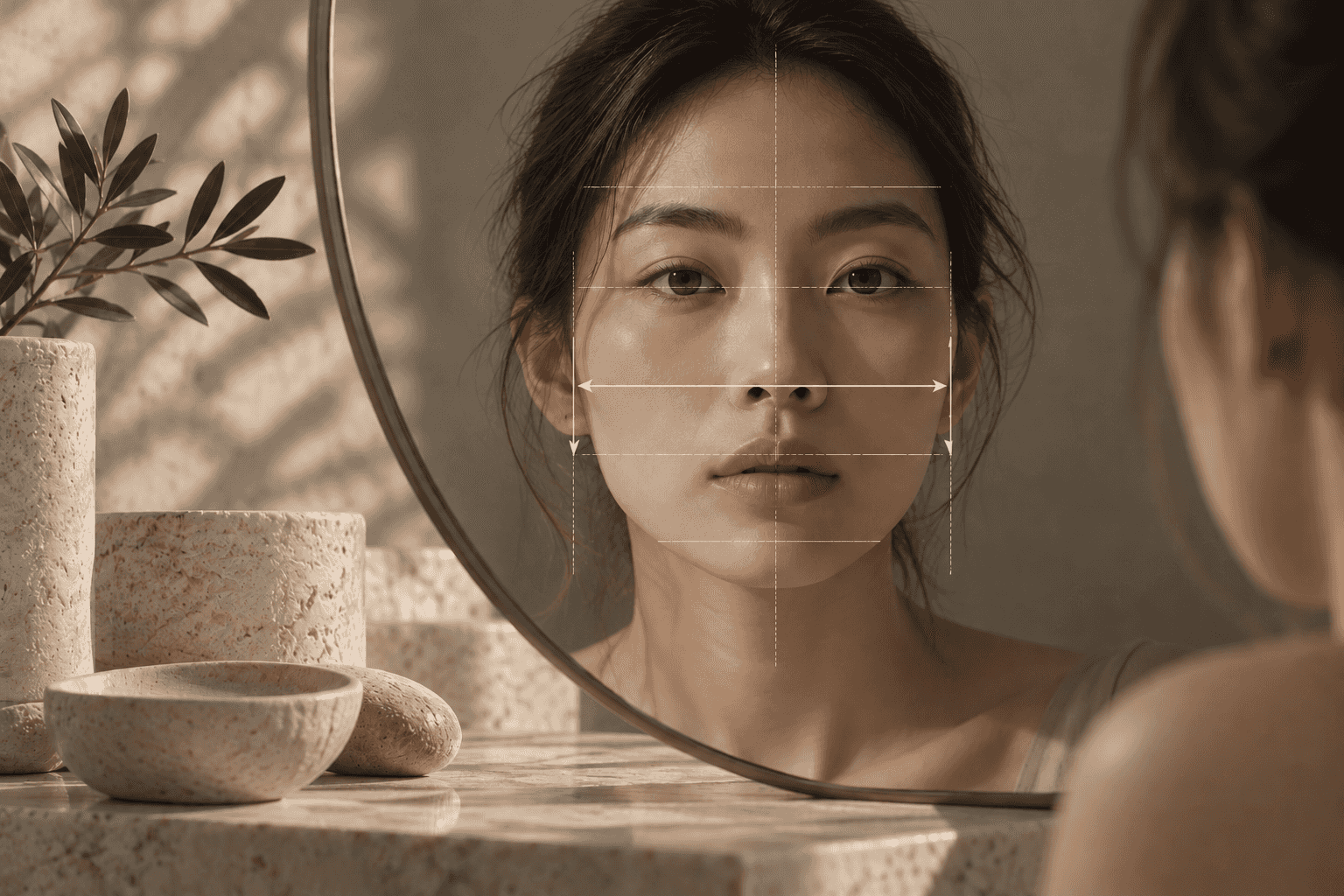
A face tends to look slimmer when its outline narrows smoothly from the cheekbones towards the chin, in proportion to the length of the face, along a clearly drawn jawline. How wide the face is matters, but it is only part of the picture.
Asian Facial Architecture™ reads this through four properties of the outline. They are a clinical way of organising what the eye sees, not a validated scientific classification:
- Width: how broad the face is, and where: at the temples, the cheekbones or the angles of the jaw
- Taper: how the outline narrows from the cheekbones towards the chin
- Length: how tall the face is for its width, including the height and shape of the chin
- Definition: how clearly the jawline reads as a line, which depends on the soft tissue over it and changes with age
Most of the studies reviewed for this article measured attractiveness rather than how slim a face looks. One exception comes from research on perceived weight. Coetzee and colleagues found that two proportions were related to body weight: face width relative to face height, and cheekbone width relative to jaw width. Observers used these proportions when judging how heavy a face looked. The faces in that study were Caucasian and African, so it does not show how Asian faces are read. It does show that people judge the weight of a face partly from its proportions.
Attractiveness research adds a second point. In a study of photographs of 450 young Han Chinese women rated for attractiveness, higher ratings went with narrower cheekbone and jaw width, but with greater width at the temples. It measured attractiveness, not slimness, and only in that population. Even so, the faces rated most attractive were not simply narrower everywhere.
Slimness is read in the outline, not measured across it.
Wide, square, round, short, heavy or undefined: six different concerns
When people say their face looks wide, they are often describing something more specific. Six appearances are commonly described this way. In a mirror they can look alike. They differ in what the eye is actually picking up, and several of them are not about width at all.
The table explains those differences. It is not a self-test. Many faces combine two or three of these, and the same appearance can have more than one cause beneath it. Telling them apart in a particular face takes an examination.
| Appearance | What the eye picks up | What may be involved | Why a narrower jaw may not change it |
|---|---|---|---|
| Wide | Width: the face is broad from side to side, often most at the cheekbones | The width of the cheekbones and of the face as a whole | If the cheekbones are the widest point, a narrower jaw can make them look wider by comparison |
| Square | Taper: the lower face stays broad to the corners of the jaw instead of narrowing towards the chin | The jaw bone, the masseter muscle, the soft tissue over them, or the jaw's width relative to the cheekbones | It depends on which of these is responsible. Square Jaw in Asian Faces explains how they are told apart |
| Round | Definition and taper: soft, curved contours with little edge at the cheek or jaw | Fullness of the soft tissue in the cheeks and lower face | The fullness may be in the cheeks rather than at the jaw |
| Short | Length: the face looks broad because there is relatively little height below the cheekbones | The vertical proportions of the face, including the height of the chin | The width may be in proportion. What the eye is reading is height |
| Heavy | Definition: fullness gathers along and below the jawline | Fat along the jaw and under the chin, and the loosening of supporting tissue with age | The fullness sits along or below the jawline, not in its width |
| Undefined | Definition: the jawline does not read as a clear line, from the front or in profile | How far the chin projects, the soft tissue along the jaw, and skin laxity | The face may not be wide at all, and less width does not make a clearer line |
Only some of these are mainly a matter of facial width. In the others, a narrower jaw may leave the feature you actually notice unchanged.
Where the width seems to come from the cheekbones, High Cheekbones vs Wide Cheekbones explains why the part of the cheekbone that looks prominent is not always the part that makes a face wide. How facial width is measured, and why photographs change it, is covered in Why Does My Face Look Wide?. How the support along the jawline loosens with age has its own timeline.
Does a longer or more projected chin make a face look slimmer?
It can change how the width above it is read. A longer chin is not automatically a slimmer face.
The chin is where the outline of the face ends. Its height, its width and how far it projects all affect how the face narrows towards it. Some of this is geometry. Two common measures of facial width compare it with facial height, so the same width over a taller face measures as relatively narrower. A narrower chin brings the two sides of the outline closer together at the bottom, and a broad chin keeps them further apart. Whether either change looks slimmer in a particular face is a matter of clinical judgement. None of the studies cited here tested it.
The 2016 consensus panel also described adding projection to features along the centre of the face, the chin among them, as creating "a visual illusion of 'narrowing'" across the whole face. That is expert opinion drawn from clinical practice, not a measured result.
A chin can also be made too long or too prominent for the face around it. A change that looks right from the front may not look right from the side, where chin and jaw read as a single line.
Can botulinum toxin to the jaw make a face V-shaped?
It can reduce width that comes from the masseter, the main chewing muscle at the corner of the jaw. It cannot create a V-shape in a face whose width comes from somewhere else.
When botulinum toxin is injected into the masseter, its primary target is the muscle itself. Its facial-slimming effect comes primarily from reducing muscle bulk. It does not address the width of the cheekbones, the length of the face or fullness elsewhere in the face.
So a face can still look wide after jaw-slimming treatment. The width may be mainly bone. The widest point may be the cheekbones. Or the appearance may be round, short or heavy rather than muscular. How much the masseter contributes is a diagnostic question, and it is best answered before treatment.
Can a jaw be made too narrow?
It can be narrowed beyond what suits the face. The evidence here is limited to one preference study, one clinical observation and expert opinion. None of it comes from studies of treatment outcomes.
In the preference study, Wu and colleagues took a photograph of one Taiwanese woman, standardised its proportions and changed only the width of the jaw on screen, from 65 to 90 per cent of the width across the cheekbones. Among 203 Taiwanese raters, the 75 per cent version scored highest and the 70 per cent version second. The most tapered version was not the most preferred. One altered photograph cannot set a target for anyone. It does show that more taper was not always rated better.
Kim and colleagues, reporting more than a thousand masseter treatments in Asian patients, noted that thinning the masseter can make the cheekbones and the angles of the jaw look relatively more prominent. A jaw reduced beneath wide cheekbones may therefore make the face look more angular at the cheek rather than slimmer. That second step is clinical reasoning, not a measured finding.
Age changes the balance too. The 2016 consensus panel noted that in older patients, with age-related volume loss and reduced skin elasticity, reducing the masseter can worsen facial appearance, with hollowing and jowl formation. This is expert opinion, not a measured outcome.
The aim is a lower face in proportion to the face above it. That is rarely the narrowest one possible.
Is a V-shaped face right for every face?
No. A V-shape is one outline among many that can be balanced and attractive. Whether it suits a particular face depends on the rest of that face: how wide the cheekbones are, how long the face is, the shape of the chin. In some faces, a broad chin or a defined jaw angle is part of what makes the face balanced.
Chin shape also differs between the sexes on average. In a CT study of 275 Korean patients, most women had a pointed chin and most men a round or square one. That describes the shape of bone in one sample. It is not a guide to what any face should look like.
The Asian Facial Architecture™ perspective
Asian Facial Architecture™, Dr. Gan Lee Ping's framework for reading each face against its own structure, begins a request for a slimmer face with the whole outline. Where is the face widest? How does it narrow towards the chin? How long is it, and how clearly is the jawline drawn? Only then comes the next question: which structures are responsible?
That order matters because treatments act on structures. Reducing a muscle, adding projection, treating soft tissue and reshaping bone are different interventions for different causes. One local treatment can be the whole answer for one face and the wrong one for another. Sometimes no treatment is the right answer.
The treatment should follow the architecture, not the trend.
Preference studies and measurements describe faces in a sample. They cannot set the right outline for an individual face, for the same reasons that the golden ratio cannot.
Before Choosing a Face-Slimming Treatment in Singapore
In Asian Facial Architecture™, the first question is not "How do I make this face narrower?" It is "What is the eye reading as width?"
An in-person assessment answers that by looking at the face from the front and in profile, at rest and in motion. It then works through what is creating the impression, what could reasonably change, and what is better left as it is.
Sometimes the most useful finding is that nothing needs to change.
Frequently Asked Questions
Can losing weight make my face look V-shaped?
It can change how full the face looks, but not the framework beneath it. In an ultrasound study of 108 young Chinese and New Zealand European women, the soft tissue over the facial bones was deeper at higher body mass index at eight of nine facial points. Losing weight may reduce that layer. It does not change the width of the cheekbones or the jaw bone, so width that is mainly skeletal remains.
Can filler make a face look slimmer?
It can change how wide a face looks by adding projection rather than removing width. The 2016 Asian consensus panel described added projection of the chin, the nose and the inner part of the cheek as creating a visual narrowing effect. It also noted that filler placed in the outer cheek could widen a midface that is already wide. These are expert opinions. Whether filler is appropriate at all depends on the face. Jawline Definition Without Overfilling discusses its limits along the jaw.
Clinical Perspective
By Dr. Gan Lee Ping
When patients tell me they want a slimmer face, I often find that “wide” is being used to describe several different things. Sometimes the jaw is genuinely broad. Sometimes the face is short, the cheeks are full, or the jawline has simply become less defined.
That is why I do not start by asking how much narrower I can make a face. I start by asking what is creating the impression of width.
The distinction matters. If the diagnosis is wrong, even a technically successful treatment may not change what the patient was seeing in the first place.
References
1. Liew S, Wu WT, Chan HH, et al. Consensus on changing trends, attitudes, and concepts of Asian beauty. Aesthetic Plast Surg. 2016;40(2):193-201.
2. Coetzee V, Chen J, Perrett DI, Stephen ID. Deciphering faces: quantifiable visual cues to weight. Perception. 2010;39(1):51-61.
3. Zhao Q, Zhou R, Zhang X, Sun H, Lu X, Xia D, Song M, Liang Y. Morphological quantitative criteria and aesthetic evaluation of eight female Han face types. Aesthetic Plast Surg. 2013;37:445-453.
4. Wu WT, Liew S, Chan HH, et al. Consensus on current injectable treatment strategies in the Asian face. Aesthetic Plast Surg. 2016;40(2):202-214.
5. Wu TY, Chou CY, Liang YM, Chang KW, Wu CH. A digital photograph study evaluating facial taperness and square face perception of Taiwanese females. J Chin Med Assoc. 2021;84(3):314-319.
6. Kim NH, Chung JH, Park RH, Park JB. The use of botulinum toxin type A in aesthetic mandibular contouring. Plast Reconstr Surg. 2005;115(3):919-930.
7. Kim B, Lee J, Lee D, Kim K, Jeong J, Jung S. An analysis of mandibular characteristics according to biological sex using three-dimensional computed tomography scans in Koreans. Medicina (Kaunas). 2026;62(2):398.
8. Baillie LJ, Mirijali SA, Niven BE, Blyth P, Dias GJ. Ancestry and BMI influences on facial soft tissue depths for a cohort of Chinese and Caucasoid women in Dunedin, New Zealand. J Forensic Sci. 2015;60(5):1146-1154.
About Dr. Gan Lee Ping
Dr. Gan Lee Ping is a Singapore-based aesthetic physician, international speaker and physician trainer. Asian Facial Architecture™ is her framework for understanding facial structure, proportion, soft tissue and ageing as one interconnected system. Her educational articles explain the anatomy and evidence behind aesthetic medicine so that readers can make informed decisions.
Consultation
Start with what is shaping the outline
An individual assessment looks at whether the concern comes from facial width, taper, length or jawline definition, and which structures are creating it, before deciding whether anything should change.
Book a ConsultationExplore Asian Facial Architecture™

Does the Golden Ratio Apply to Asian Faces?
The golden ratio may describe some faces. The evidence does not support using it to define beauty, or to decide what a face should become.
· 9 min
Why Does My Face Look Wide? Understanding Facial Width
A face can look wide for more than one reason. The sources reviewed here measure width in more than one way, and they do not agree on where "wide" begins.
· 11 min

Square Jaw in Asian Faces: Is It Bone, Masseter Muscle or Soft Tissue?
A square jaw is a shape, not a diagnosis. Bone, muscle, soft tissue and proportion can each create it, and the reason matters more than the shape.
· 10 min